
Saturday, October 29, 2011
Birding Babylon
There's a saying, "wherever you go, there you are." More to the point, wherever you go, you'll find nature. I'm always amazed at the tenacity of nature, a weed growing up through the cracked pavement of an industrial landscape, the bee that pollinates the weed flower, the spider hiding in the weed that captures the bee, the wasp that stings the spider and takes it back to its nest to lay an egg to feed its hatching larva. There you are. And so it is, in present-day Iraq, that nature perseveres among the explosions and death. Amid that chaos, Sergeant Jonathan Trouern-Trend kept online journal of his birding and nature observations. The highlights of these blog posts are assembled in this small book. Hope springs eternal like the weed that grows up through the crack.


Sunday, October 16, 2011
Fall: On the Beach
It's fall and the Heerman's gulls again make their contrarian fall migration northward from Baja California to our local beaches and elsewhere along the northern Pacific coastline. Other gulls are here, too, but my identification skills with the other gull species are not so good, especially with the juvenile phases and subtle seasonal variations. The American widgeons are here and later in the winter we'll see other ducks, the red-breasted mergansers and the goldeneyes, common and Barrows.


 I encountered several beached lion's mane jellyfish (Cyanea capillata), the largest known species of jellyfish. Jellyfish usually die off this time of year as their food supply of plankton dwindles.
 Harbor seals are the most abundant marine mammal in Puget Sound. Harbor seal pups can be found on the beach in the late summer and fall, resting as mother forages. People may come across a seal pup on the beach and think it is abandoned but it is not. The pups must not be disturbed. Seal Sitters is a volunteer group dedicated to the protection of marine mammals in the urban environment along Puget Sound. I came across a Seal Pup last year but this year I came across one that was unfortunately dead. Seal pup mortality is relatively high as I understand.


Friday, October 14, 2011
Fall: From the Woods to the Mailbox
We live on the edge of a 120-acre forest of western hemlock, western cedar, and Douglas fir with bigleaf maple and red alder nearing the end of their lifespan. In another 700 feet as the crow flies is the shore of Puget Sound. And so we are blessed with a variety of wild plants and animals from rain forest to suburban garden to the shoreline of an inland sea.
Even among the giant trees I'm never at a loss of amazement at the small things. Walking out to the mailbox I notice a lifeless garter snake on the driveway that was run over by any one of us three neighbors who share this driveway. I'm not a snake expert but guessing he's a Northwestern Garter Snake (Thamnophis ordinoides), one of several species and subspecies of garter snakes native here. Its lifeless opaque eyes no longer glisten as transparent windows to his snake spirit.
 As I was photographing the snake, along came a beetle, a snail-killer carabid (Scaphinotus angusticollis), attracted no doubt by the scent of the dead snake. These beetles are pretty common around here and are the good guys that eat snails and slugs. The beetle's forebody is uniquely shaped to get inside a snail's shell. Note that the beetle harbors a group of mites seen as the orangish little creatures on the beetle's thorax.
 Another common animal is the seldom seen shrew-mole (Neurotrichus gibbsii). They forage for worms and other terrestrial invertebrates in the shallow soil and leaf letter. I found this one dead at the edge of the forest.
 Fall is also mushroom time, these found growing in our back lawn area, perhaps Mycena sp.
 There weren't as may cross spiders this fall as last year, maybe our early November last year freeze reduced their numbers. It was a cold La Nina last year and this year looks to be a similar La Nina. We'll see.
Even among the giant trees I'm never at a loss of amazement at the small things. Walking out to the mailbox I notice a lifeless garter snake on the driveway that was run over by any one of us three neighbors who share this driveway. I'm not a snake expert but guessing he's a Northwestern Garter Snake (Thamnophis ordinoides), one of several species and subspecies of garter snakes native here. Its lifeless opaque eyes no longer glisten as transparent windows to his snake spirit.


Wednesday, October 5, 2011
McIntosh
Back in the Stone Age when I was in college in the late 1970s, I had an introductory computer class where we did goofy little programming assignments using BASIC and working on terminals connected to the college's big Digital PDP-11. One of my professor's had just purchased a TRS-80, one of the original desktop computers. I had no clue then how much computers would become literally a household appliance. After graduating from college I went to work for a huge aerospace company as a manufacturing engineer. I wrote production planning on a terminal connected to some mainframe elsewhere in the building. Our group had a secretary who would type letters for us on an IBM Selectric typewriter. After four years of flirting with the girls on the soldering line, I was beginning to realize that I wasn't really cutout to work in a giant corporation. But I was liking too much the engineer salary to make a move. Fortunately, the company made a decision for me and laid me off. After a few weeks of job searching, interviewing with dreadful manufacturing facilities and sad looking people, I landed a job with an environmental consulting company. I walked in for the interview and knew right then and there that that was where I wanted to be. The people were happy and energetic. The office was quaintly located in the original Sierra Madre city hall and every desk was equipped with a McIntosh 512. In short time, I was writing reports and drawing plans, all on that little box. For the next five years, it was nothing but McIntosh's, graduating from the 512 to the SE and later purchasing a McIntosh LC for home use. It had a color monitor, which was the coolest thing since the Vega-matic. Somewhere in the early 1990s the company transitioned over to PCs with Windows and that was it. Pretty soon it was all Windows all the time.
Rest in peace Steve Jobs. You made some awesome products and brought Apple back to glory with fantastic new products. History will view you right up there with Leonardo da Vinci as a genius visionary.

Rest in peace Steve Jobs. You made some awesome products and brought Apple back to glory with fantastic new products. History will view you right up there with Leonardo da Vinci as a genius visionary.
Tuesday, April 19, 2011
Manastash Ridge
Sick of gloomy gray skies, I and older son headed over the Pass to the wide open spaces and maybe a little sunshine. We chose the Westberg Trail, number 9 in the Best Desert Hikes book (Bauer & Nelson), for its nearness and the promise of great views, flowers, and birds. Geoff, the newly minted driver, got great practice driving freeway for a long distance while I kicked back and enjoyed the scenery. Obligatory stop in Cle Elum at Pioneer Coffee for a wakeup and Safeway for their signature sandwiches for later lunch on the trail.

The Westberg Trail (aka Ridge Trail) wastes no time in heading directly up 1800 feet to the crest of Monastash Ridge, mostly in open country with generous views over the Kittitas Valley to the cloud-shrouded Stuart Range. Only the earliest of spring flowers were out; grass widows, gold fields, yellow bells, sagebrush buttercups, and sagebrush violets. Thankfully no ticks and somewhat disappointingly no rattlesnakes for I love the heightened sense of one’s surroundings that the specter of encountering a rattlesnake brings.


 At the top of the ridge, the trail ends at the Westberg Memorial. The wind was gusting to 22 mph giving a wind chill factor of 33 degrees according to a fancy new toy I bought off Amazon, a Kestrel 2500 pocket weather meter. We considered following the dirt road that snakes along the ridge to the UW Observatory but first we had to find a sheltered place out of the wind for lunch. I spied a lone Ponderosa to the lee south out on a side ridge about a quarter mile away. It was a young tree with branches almost touching the ground offering the promise of a sheltered area out of the wind and so it was. We enjoyed our lunch there under the tree with the wind rustling the branches overhead and a floor cushioned by pine needles and a few token owl pellets.


From our lunch vantage, we spied a stock pond a little further south down a draw between us and the opposite side ridge. The power of the pond compelled us and so we packed up and headed to the pond across the open country that offered little resistance to foot travel. The pond in and of itself wasn’t too exciting except for the large thatch mound of a wood ant colony (Formica rufa) on top of the earthen dam that forms the pond.


Leaving the pond, we followed the trace of a four-wheel drive road back to the main ridge and connecting again with the trail. Just below the ridge crest, the trail forks near an old broken Ponderosa pine marking the junction to an alternative trail to the bottom. This trail enters a wooded area of Ponderosa pine and Douglas fir at the head of a side canyon. Here we flushed a grouse. The trail follows the canyon all the way down to the irrigation ditch service road and then back to the trailhead. Near the bottom of the canyon we found a deer skull among the new spring grass, a testimony to the callousness of winter and the promise of spring.


The Westberg Trail (aka Ridge Trail) wastes no time in heading directly up 1800 feet to the crest of Monastash Ridge, mostly in open country with generous views over the Kittitas Valley to the cloud-shrouded Stuart Range. Only the earliest of spring flowers were out; grass widows, gold fields, yellow bells, sagebrush buttercups, and sagebrush violets. Thankfully no ticks and somewhat disappointingly no rattlesnakes for I love the heightened sense of one’s surroundings that the specter of encountering a rattlesnake brings.


From our lunch vantage, we spied a stock pond a little further south down a draw between us and the opposite side ridge. The power of the pond compelled us and so we packed up and headed to the pond across the open country that offered little resistance to foot travel. The pond in and of itself wasn’t too exciting except for the large thatch mound of a wood ant colony (Formica rufa) on top of the earthen dam that forms the pond.


Leaving the pond, we followed the trace of a four-wheel drive road back to the main ridge and connecting again with the trail. Just below the ridge crest, the trail forks near an old broken Ponderosa pine marking the junction to an alternative trail to the bottom. This trail enters a wooded area of Ponderosa pine and Douglas fir at the head of a side canyon. Here we flushed a grouse. The trail follows the canyon all the way down to the irrigation ditch service road and then back to the trailhead. Near the bottom of the canyon we found a deer skull among the new spring grass, a testimony to the callousness of winter and the promise of spring.


Saturday, February 26, 2011
Bird Boxes
We have two bird boxes around our house. The ideal time to clean them out is about August or September, right after nesting season. At work I'm very focused on deadlines and schedules. At home I downshift into a slower, less frenzied pace. Because of that, the bird boxes usually don't get cleaned until January or February, just before nesting season.
Here's the location of bird box #1, about 12 feet up on the trunk of a large Douglas fir just on the other side of our back fence (photo in May 2010).
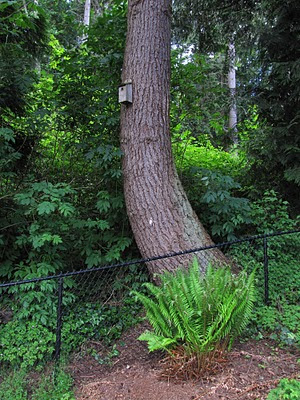
Bird box #1 has been used by chestnut-backed chickadees for almost 20 years, except for one year when I didn't clean it out and it was colonized by bumblebees.
Bird box #2 was moved out by our back door last year and black-capped chickadees nested here for the first time. Before I moved it by the back door it was hanging in an old camellia bush and was used only once by house wrens.

This year's clean out shows the chickadee's nests constructed of moss and lined with soft fuzz and dog hair, no doubt from our dog.


Doing yard work, trimming back western sword ferns that create a fern grotto in a corner of the backyard, I found a couple nests. These are probably spotted towhee nests, who keep their nests low. The outer foundation layer is shredded cedar bark then lined with woven grass.

Here's the location of bird box #1, about 12 feet up on the trunk of a large Douglas fir just on the other side of our back fence (photo in May 2010).

Bird box #1 has been used by chestnut-backed chickadees for almost 20 years, except for one year when I didn't clean it out and it was colonized by bumblebees.
Bird box #2 was moved out by our back door last year and black-capped chickadees nested here for the first time. Before I moved it by the back door it was hanging in an old camellia bush and was used only once by house wrens.

This year's clean out shows the chickadee's nests constructed of moss and lined with soft fuzz and dog hair, no doubt from our dog.


Doing yard work, trimming back western sword ferns that create a fern grotto in a corner of the backyard, I found a couple nests. These are probably spotted towhee nests, who keep their nests low. The outer foundation layer is shredded cedar bark then lined with woven grass.

Saturday, February 5, 2011
Driving 99
My interest in old roads goes back to my childhood when I would pack up into the backseat of the 57 Chevy and we'd travel US 66, the Mother Road, from LA to Detroit. Those trips were epic multi-day journeys on mostly two-lane highways across an ever-changing landscape. The gas stations were full service. Stops at Stuckey's yielded their famous pecan logs to enjoy in bits and pieces passed back to me by my mother from the front seat.
On a recent family trip across the western US, we drove the section of Route 66 westward from Seligman to Kingman, Arizona. Once past the kitsch and overly restored Route 66 nostalgia of Seligman, the trip did bring back fond memories of wide open desert valleys and distant mountain ranges as the passing telephone poles counted the way.
Old Highway 99 is the north-south version of the east-west Route 66. Before Interstate 5, US 99 was the principal north-south highway between Los Angeles on up past Seattle to the Canadian border. This was the other highway of my youth for our family camping trips to Oregon and Washington.
I get down to Portland occasionally which entails driving Interstate 5 from my homebase in Pugetopolis. Given time, I'll try to drive a segment of Old 99. Recently I drove a section of the Old Pacific Highway (99) northward from Kelso to just past the Toutle River reconnecting to I-5 at Exit 52. The route follows the Cowlitz River and passes through the small town of Castle Rock.
I paused and made a stop where the road crosses the Toutle River to indulge my other interests, bridges and rivers. The bridge here was constructed in 1935 and was the main route of US 99 until Interstate 5 was completed here in 1969. With that, the US 99 designation was abandoned in Washington State.
The 1935 bridge is a classic "camelback" truss bridge, specifically a riveted, 10-panel Pennsylvania through truss, a modification of the basic Pratt truss structure. Evidence of an earlier bridge includes a large piece of concrete pier visible to the left and a stone masonry bridge abutment on the right bank, both in front of the 1935 bridge. I have been unable, so far, to find any information on an older bridge.

DudeDiligence

Cowlitz County GIS
When Mount St. Helens erupted on Sunday morning, May 18, 1980, it sent a surge of steaming mud and debris down the Toutle River. Our 1935 bridge was spared but another road bridge upstream on the North Fork Toutle River was taken out by the mudflow. The following photo (USGS) was taken from our 1935 bridge shortly after the eruption and looks downstream to the Interstate 5 bridges constructed in 1969. A mudline left behind on trees shows depths reached by the mud.

USGS
Before heading home, I picked up a few nice, rounded, river rocks for the home landscape. The rocks are beautiful porphyritic volcanic rocks washed down from Mount St. Helens.
On a recent family trip across the western US, we drove the section of Route 66 westward from Seligman to Kingman, Arizona. Once past the kitsch and overly restored Route 66 nostalgia of Seligman, the trip did bring back fond memories of wide open desert valleys and distant mountain ranges as the passing telephone poles counted the way.
Old Highway 99 is the north-south version of the east-west Route 66. Before Interstate 5, US 99 was the principal north-south highway between Los Angeles on up past Seattle to the Canadian border. This was the other highway of my youth for our family camping trips to Oregon and Washington.
I get down to Portland occasionally which entails driving Interstate 5 from my homebase in Pugetopolis. Given time, I'll try to drive a segment of Old 99. Recently I drove a section of the Old Pacific Highway (99) northward from Kelso to just past the Toutle River reconnecting to I-5 at Exit 52. The route follows the Cowlitz River and passes through the small town of Castle Rock.
I paused and made a stop where the road crosses the Toutle River to indulge my other interests, bridges and rivers. The bridge here was constructed in 1935 and was the main route of US 99 until Interstate 5 was completed here in 1969. With that, the US 99 designation was abandoned in Washington State.
The 1935 bridge is a classic "camelback" truss bridge, specifically a riveted, 10-panel Pennsylvania through truss, a modification of the basic Pratt truss structure. Evidence of an earlier bridge includes a large piece of concrete pier visible to the left and a stone masonry bridge abutment on the right bank, both in front of the 1935 bridge. I have been unable, so far, to find any information on an older bridge.

DudeDiligence

Cowlitz County GIS
When Mount St. Helens erupted on Sunday morning, May 18, 1980, it sent a surge of steaming mud and debris down the Toutle River. Our 1935 bridge was spared but another road bridge upstream on the North Fork Toutle River was taken out by the mudflow. The following photo (USGS) was taken from our 1935 bridge shortly after the eruption and looks downstream to the Interstate 5 bridges constructed in 1969. A mudline left behind on trees shows depths reached by the mud.

USGS
Before heading home, I picked up a few nice, rounded, river rocks for the home landscape. The rocks are beautiful porphyritic volcanic rocks washed down from Mount St. Helens.
Subscribe to:
Posts (Atom)


